TWO REAL PAGES FROM THE GUIDE
Call Every Brother
These are previews from the corrected guide. Page numbers refer to the complete book; read its instructions before using an individual form. The images are for preview, not fillable worksheets. Select an image to enlarge it, or open its text version.
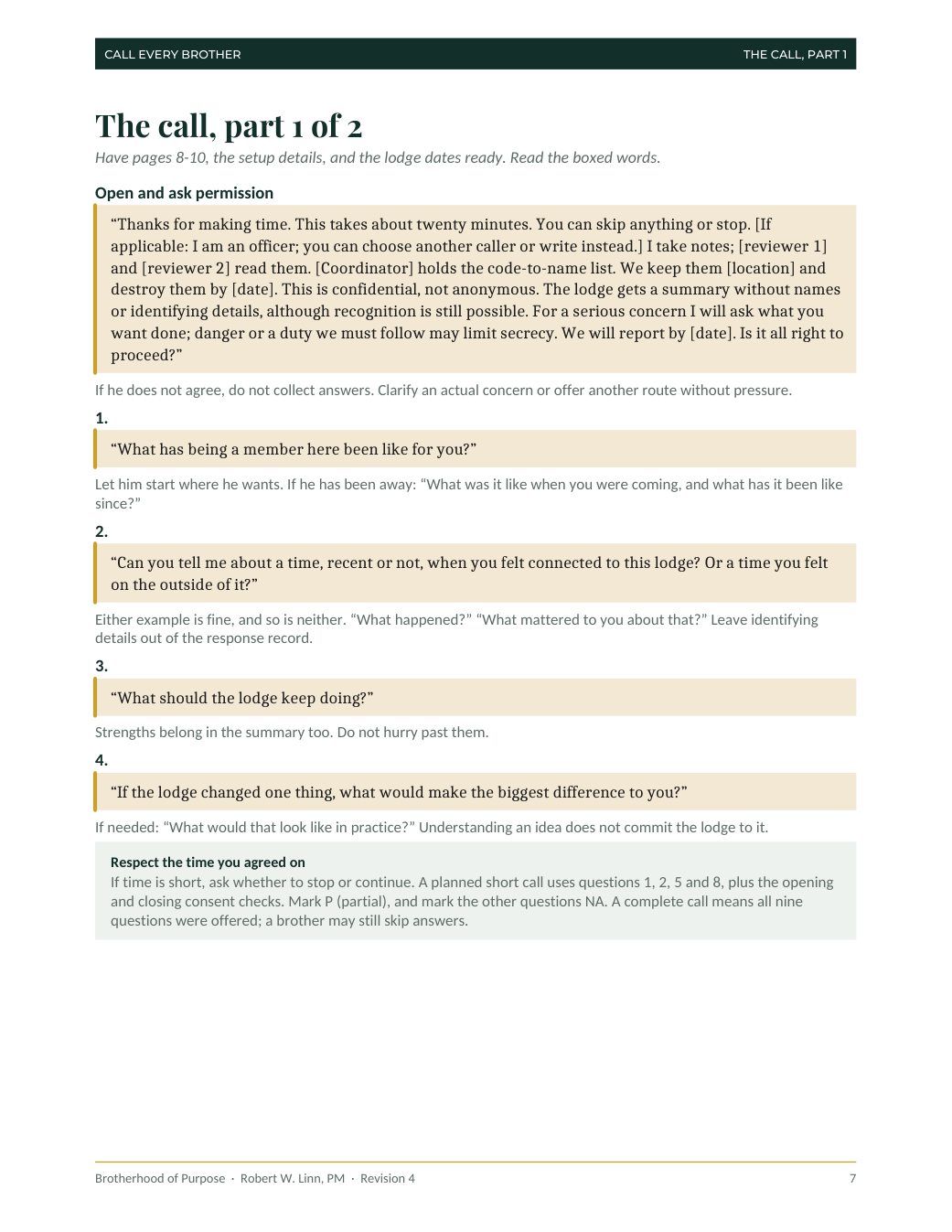
Read this page as text
The call, part 1 of 2
Have pages 8-10, the setup details, and the lodge dates ready. Read the boxed words.
Open and ask permission
“Thanks for making time. This takes about twenty minutes. You can skip anything or stop. [If
applicable: I am an officer; you can choose another caller or write instead.] I take notes; [reviewer 1]
and [reviewer 2] read them. [Coordinator] holds the code-to-name list. We keep them [location] and
destroy them by [date]. This is confidential, not anonymous. The lodge gets a summary without names
or identifying details, although recognition is still possible. For a serious concern I will ask what you
want done; danger or a duty we must follow may limit secrecy. We will report by [date]. Is it all right to
proceed?”
If he does not agree, do not collect answers. Clarify an actual concern or offer another route without pressure.
1.
“What has being a member here been like for you?”
Let him start where he wants. If he has been away: “What was it like when you were coming, and what has it been like
since?”
2.
“Can you tell me about a time, recent or not, when you felt connected to this lodge? Or a time you felt
on the outside of it?”
Either example is fine, and so is neither. “What happened?” “What mattered to you about that?” Leave identifying
details out of the response record.
3.
“What should the lodge keep doing?”
Strengths belong in the summary too. Do not hurry past them.
4.
“If the lodge changed one thing, what would make the biggest difference to you?”
If needed: “What would that look like in practice?” Understanding an idea does not commit the lodge to it.
Respect the time you agreed on
If time is short, ask whether to stop or continue. A planned short call uses questions 1, 2, 5 and 8, plus the opening
and closing consent checks. Mark P (partial), and mark the other questions NA. A complete call means all nine
questions were offered; a brother may still skip answers.
CALL EVERY BROTHER
THE CALL, PART 1
Brotherhood of Purpose  ·  Robert W. Linn, PM  ·  Revision 4
7
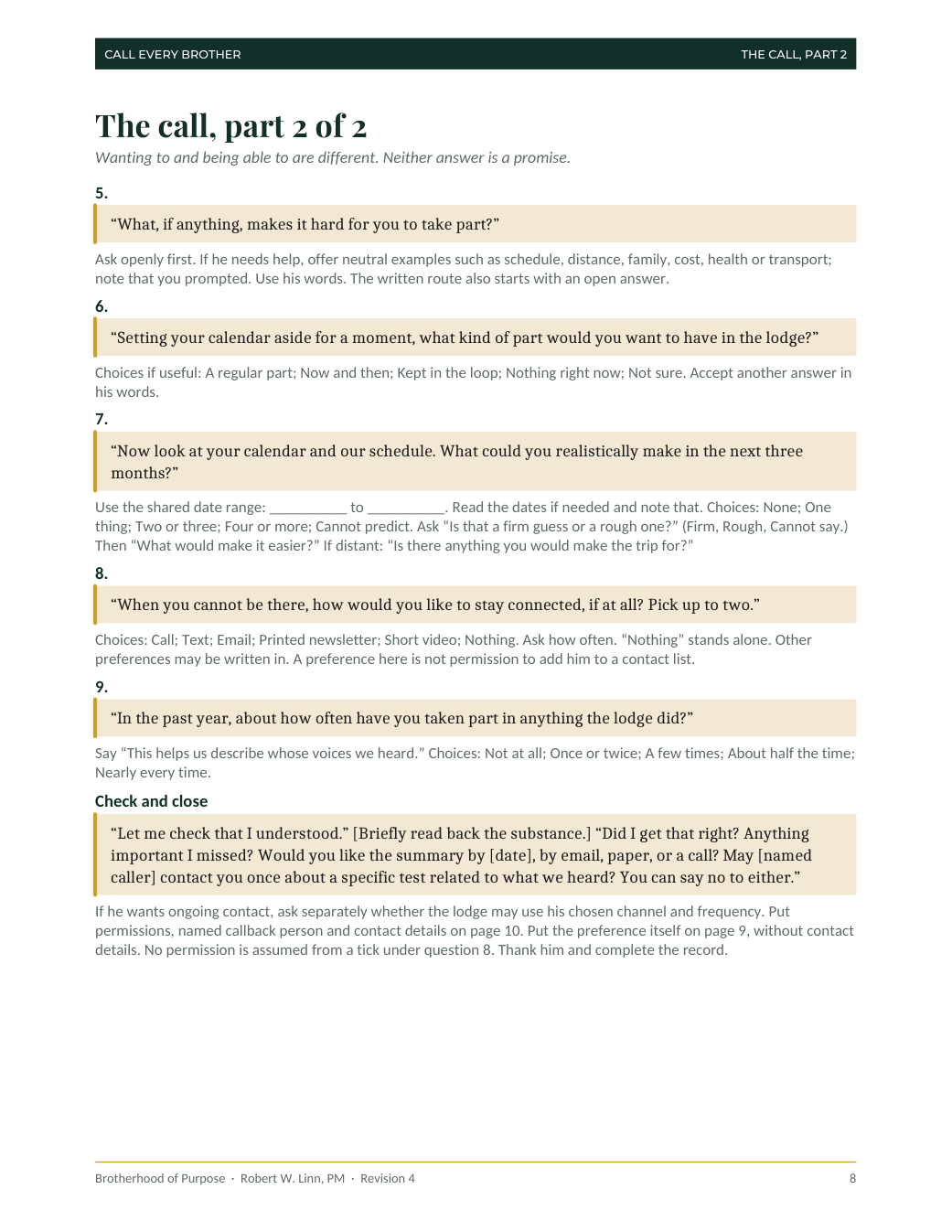
Read this page as text
The call, part 2 of 2
Wanting to and being able to are different. Neither answer is a promise.
5.
“What, if anything, makes it hard for you to take part?”
Ask openly first. If he needs help, offer neutral examples such as schedule, distance, family, cost, health or transport;
note that you prompted. Use his words. The written route also starts with an open answer.
6.
“Setting your calendar aside for a moment, what kind of part would you want to have in the lodge?”
Choices if useful: A regular part; Now and then; Kept in the loop; Nothing right now; Not sure. Accept another answer in
his words.
7.
“Now look at your calendar and our schedule. What could you realistically make in the next three
months?”
Use the shared date range: __________ to __________. Read the dates if needed and note that. Choices: None; One
thing; Two or three; Four or more; Cannot predict. Ask “Is that a firm guess or a rough one?” (Firm, Rough, Cannot say.)
Then “What would make it easier?” If distant: “Is there anything you would make the trip for?”
8.
“When you cannot be there, how would you like to stay connected, if at all? Pick up to two.”
Choices: Call; Text; Email; Printed newsletter; Short video; Nothing. Ask how often. “Nothing” stands alone. Other
preferences may be written in. A preference here is not permission to add him to a contact list.
9.
“In the past year, about how often have you taken part in anything the lodge did?”
Say “This helps us describe whose voices we heard.” Choices: Not at all; Once or twice; A few times; About half the time;
Nearly every time.
Check and close
“Let me check that I understood.” [Briefly read back the substance.] “Did I get that right? Anything
important I missed? Would you like the summary by [date], by email, paper, or a call? May [named
caller] contact you once about a specific test related to what we heard? You can say no to either.”
If he wants ongoing contact, ask separately whether the lodge may use his chosen channel and frequency. Put
permissions, named callback person and contact details on page 10. Put the preference itself on page 9, without contact
details. No permission is assumed from a tick under question 8. Thank him and complete the record.
CALL EVERY BROTHER
THE CALL, PART 2
Brotherhood of Purpose  ·  Robert W. Linn, PM  ·  Revision 4
8
Robert W. Linn, PM · Brotherhood of Purpose · Bosley Press