FOUR REAL PAGES FROM THE CURRENT BOOKLET
Let Him Talk
Try an invitation with invented names and no recorder. See a filled plan before making your own.
These are pages from the 35-page revised booklet. The included Records Companion is required before any real recording. Recording, access and each later use are separate choices. These practice pages grant no permission.
Try the complete practice kit · no charge Get all forty question groups
Read this page as text
Brotherhood of Purpose · Practical Guides
Robert W. Linn, PM | Bosley Press | LT24
3
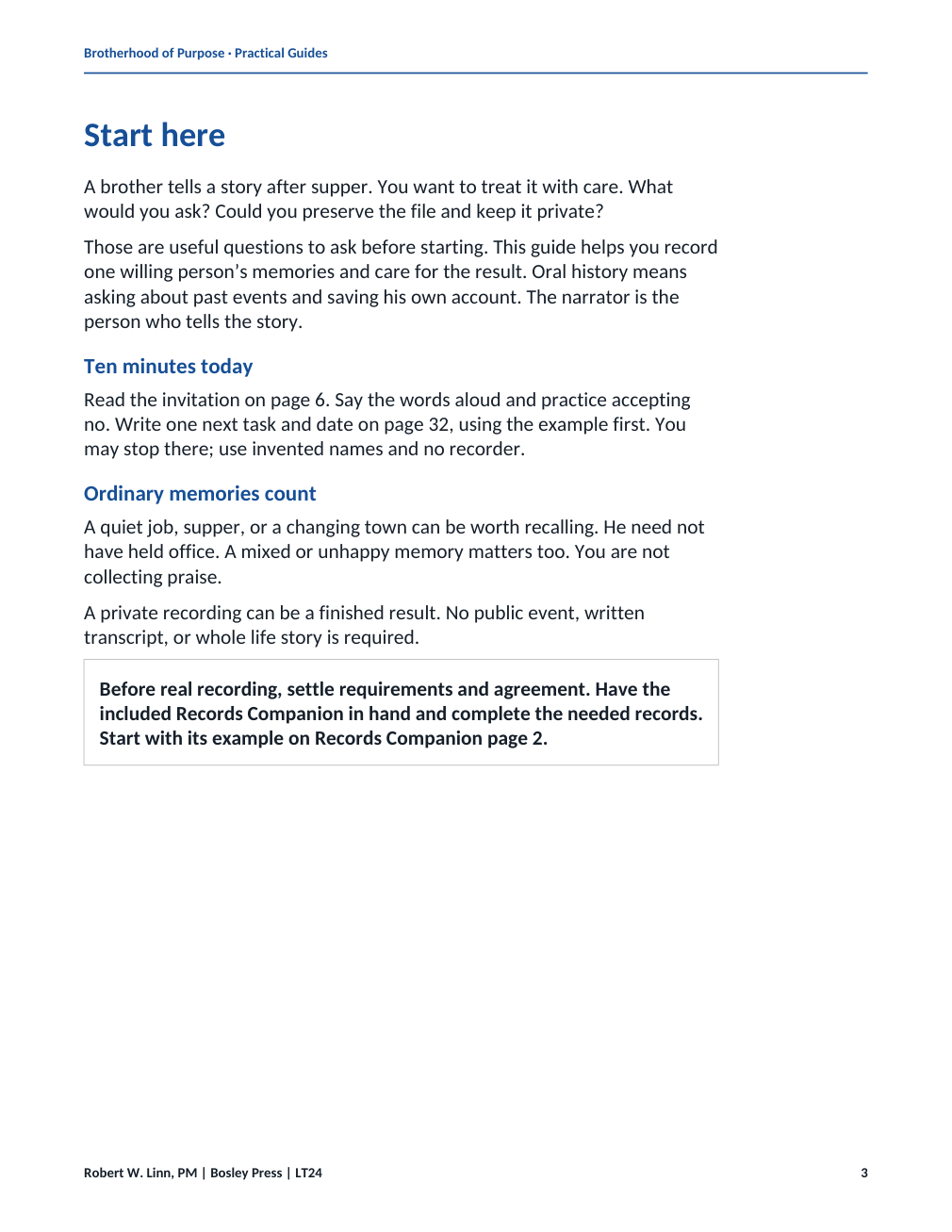
Start here
A brother tells a story after supper. You want to treat it with care. What
would you ask? Could you preserve the file and keep it private?
Those are useful questions to ask before starting. This guide helps you record
one willing person’s memories and care for the result. Oral history means
asking about past events and saving his own account. The narrator is the
person who tells the story.
Ten minutes today
Read the invitation on page 6. Say the words aloud and practice accepting
no. Write one next task and date on page 32, using the example first. You
may stop there; use invented names and no recorder.
Ordinary memories count
A quiet job, supper, or a changing town can be worth recalling. He need not
have held office. A mixed or unhappy memory matters too. You are not
collecting praise.
A private recording can be a finished result. No public event, written
transcript, or whole life story is required.
Before real recording, settle requirements and agreement. Have the
included Records Companion in hand and complete the needed records.
Start with its example on Records Companion page 2.
Read this page as text
Brotherhood of Purpose · Practical Guides
Robert W. Linn, PM | Bosley Press | LT24
6
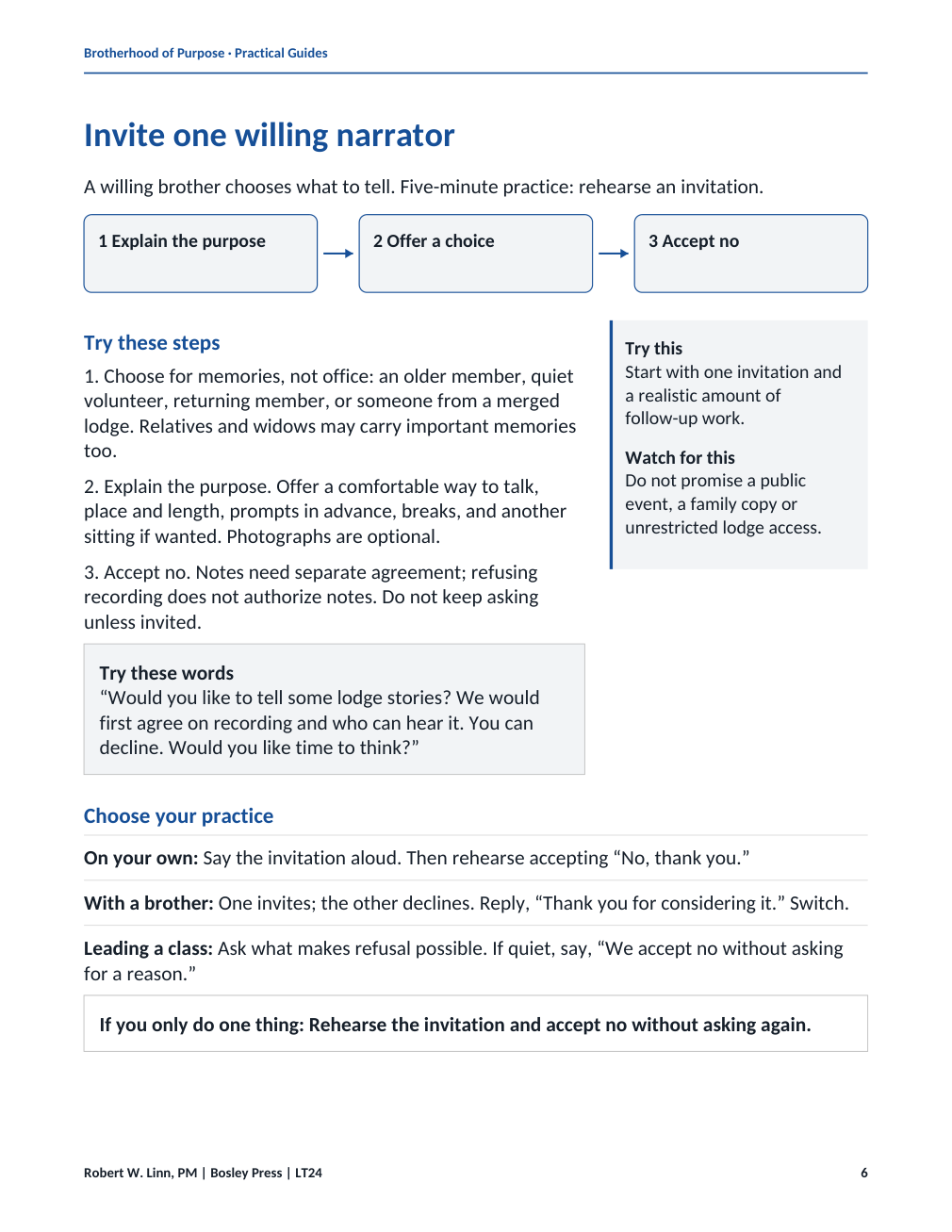
Invite one willing narrator
A willing brother chooses what to tell. Five-minute practice: rehearse an invitation.
1 Explain the purpose
2 Offer a choice
3 Accept no
Try these steps
1. Choose for memories, not office: an older member, quiet
volunteer, returning member, or someone from a merged
lodge. Relatives and widows may carry important memories
too.
2. Explain the purpose. Offer a comfortable way to talk,
place and length, prompts in advance, breaks, and another
sitting if wanted. Photographs are optional.
3. Accept no. Notes need separate agreement; refusing
recording does not authorize notes. Do not keep asking
unless invited.
Try these words
“Would you like to tell some lodge stories? We would
first agree on recording and who can hear it. You can
decline. Would you like time to think?”
Try this
Start with one invitation and
a realistic amount of
follow-up work.
Watch for this
Do not promise a public
event, a family copy or
unrestricted lodge access.
Choose your practice
On your own: Say the invitation aloud. Then rehearse accepting “No, thank you.”
With a brother: One invites; the other declines. Reply, “Thank you for considering it.” Switch.
Leading a class: Ask what makes refusal possible. If quiet, say, “We accept no without asking
for a reason.”
If you only do one thing: Rehearse the invitation and accept no without asking again.
Read this page as text
Brotherhood of Purpose · Practical Guides
Robert W. Linn, PM | Bosley Press | LT24
31
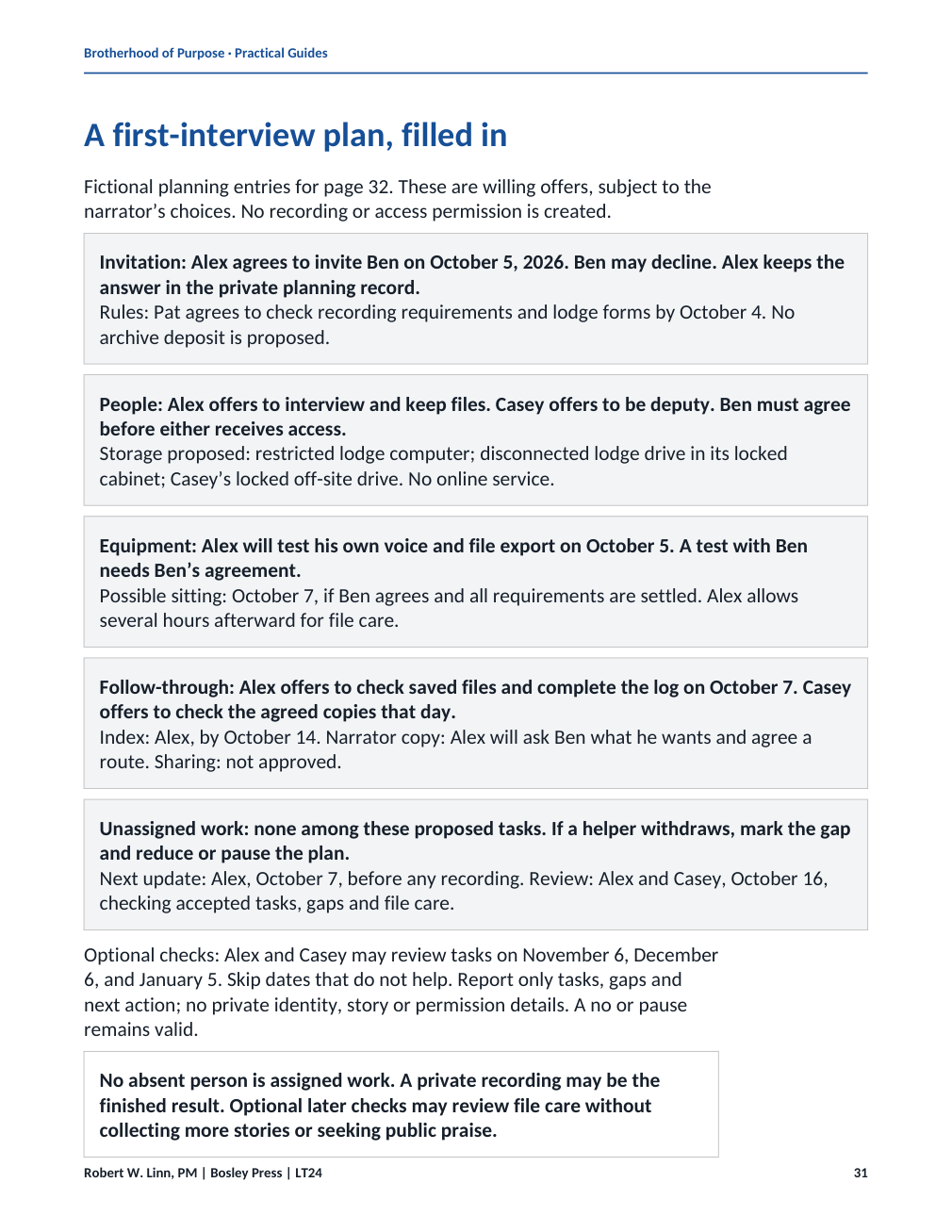
A first-interview plan, filled in
Fictional planning entries for page 32. These are willing offers, subject to the
narrator’s choices. No recording or access permission is created.
Invitation: Alex agrees to invite Ben on October 5, 2026. Ben may decline. Alex keeps the
answer in the private planning record.
Rules: Pat agrees to check recording requirements and lodge forms by October 4. No
archive deposit is proposed.
People: Alex offers to interview and keep files. Casey offers to be deputy. Ben must agree
before either receives access.
Storage proposed: restricted lodge computer; disconnected lodge drive in its locked
cabinet; Casey’s locked off-site drive. No online service.
Equipment: Alex will test his own voice and file export on October 5. A test with Ben
needs Ben’s agreement.
Possible sitting: October 7, if Ben agrees and all requirements are settled. Alex allows
several hours afterward for file care.
Follow-through: Alex offers to check saved files and complete the log on October 7. Casey
offers to check the agreed copies that day.
Index: Alex, by October 14. Narrator copy: Alex will ask Ben what he wants and agree a
route. Sharing: not approved.
Unassigned work: none among these proposed tasks. If a helper withdraws, mark the gap
and reduce or pause the plan.
Next update: Alex, October 7, before any recording. Review: Alex and Casey, October 16,
checking accepted tasks, gaps and file care.
Optional checks: Alex and Casey may review tasks on November 6, December
6, and January 5. Skip dates that do not help. Report only tasks, gaps and
next action; no private identity, story or permission details. A no or pause
remains valid.
No absent person is assigned work. A private recording may be the
finished result. Optional later checks may review file care without
collecting more stories or seeking public praise.
Read this page as text
Brotherhood of Purpose · Practical Guides
Robert W. Linn, PM | Bosley Press | LT24
32
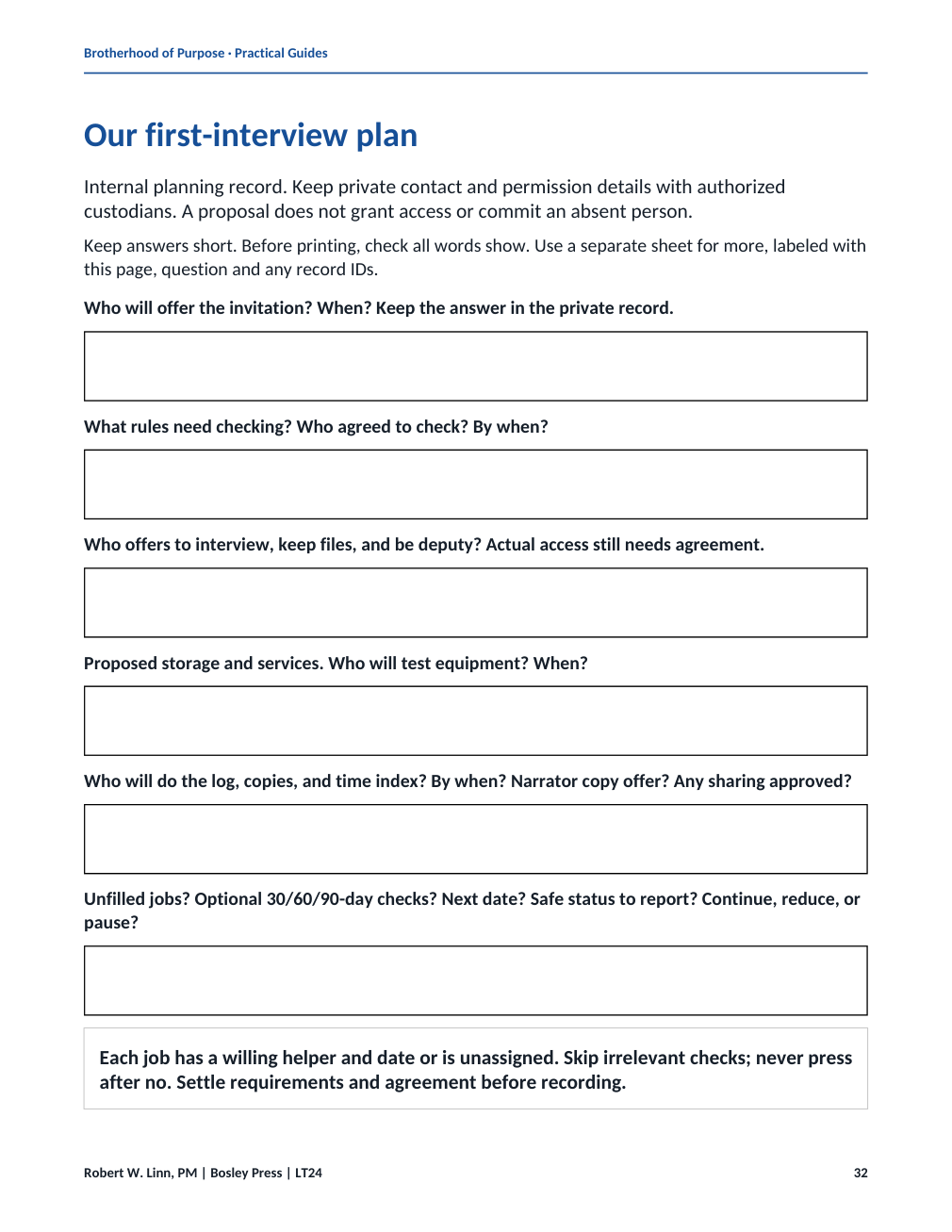
Our first-interview plan
Internal planning record. Keep private contact and permission details with authorized
custodians. A proposal does not grant access or commit an absent person.
Keep answers short. Before printing, check all words show. Use a separate sheet for more, labeled with
this page, question and any record IDs.
Who will offer the invitation? When? Keep the answer in the private record.
What rules need checking? Who agreed to check? By when?
Who offers to interview, keep files, and be deputy? Actual access still needs agreement.
Proposed storage and services. Who will test equipment? When?
Who will do the log, copies, and time index? By when? Narrator copy offer? Any sharing approved?
Unfilled jobs? Optional 30/60/90-day checks? Next date? Safe status to report? Continue, reduce, or
pause?
Each job has a willing helper and date or is unassigned. Skip irrelevant checks; never press
after no. Settle requirements and agreement before recording.
See the booklet and records companion · $7
Robert W. Linn, PM · Brotherhood of Purpose · Practical Guides · Bosley Press